Software Development
ERP Development
ERP development is about centralizing operations and reporting that currently live scattered across spreadsheets, disconnected tools, and tribal knowledge held by whoever's been at the company longest. Quinoid builds custom ERP systems for companies centralizing operations and reporting across India and international markets, designing modules for finance, inventory, procurement, and HR that share one consistent data model instead of forcing your team to reconcile numbers between systems that don't agree. We've built multi-module platforms handling finance and compliance workflows where data accuracy isn't optional, which shapes how rigorously we approach data validation and audit trails in every ERP engagement. Unlike packaged ERP software that charges for modules you'll never use and requires expensive consultants just to configure, we build only the modules your operations actually need, with reporting views designed around the decisions your leadership team actually makes. Migration from existing spreadsheets or legacy systems is planned as a first-class part of the project, not an afterthought, because an ERP that launches with incomplete or inconsistent historical data loses trust before it's had a chance to prove its value.
What We Deliver
Finance & Accounting Module Development
We build finance modules covering invoicing, expense tracking, and financial reporting with audit trails built into the data model, so every transaction is traceable and reconcilable rather than requiring manual cross-checking at month-end close.
Inventory & Procurement Management
We build inventory tracking and procurement workflows tied directly to the finance module, so stock levels, purchase orders, and cost data stay consistent across the system instead of requiring manual reconciliation between disconnected tools.
Cross-Module Reporting & Dashboards
We design reporting views that pull from finance, inventory, and operations modules together, giving leadership a single accurate picture instead of needing to manually combine exports from separate systems before every meeting.
Legacy Data Migration & System Consolidation
We plan and execute migration from spreadsheets or legacy software into the new ERP, validating historical data for consistency before cutover, since an ERP launched with inaccurate historical data undermines trust in the system from day one.
Delivery Process
Operations and module requirements audit
We map which operational areas — finance, inventory, procurement, HR — need centralizing and in what priority order, since not every ERP engagement needs every module built simultaneously.
Unified data model design
We design a single consistent data model spanning all planned modules upfront, preventing the data inconsistency between modules that plagues ERPs built as disconnected pieces stitched together later.
Module-by-module development
We build and validate each module against real operational data, prioritizing the modules with the highest current pain — usually finance or inventory — before expanding to others.
Legacy data migration and validation
We migrate historical data from spreadsheets or legacy systems with explicit validation steps, catching inconsistencies before they become embedded as "facts" inside the new system.
Phased rollout with leadership reporting
We roll out module by module, with cross-module reporting dashboards validated against manually calculated figures before leadership starts relying on them for decisions.
Business Outcomes
A single operational source of truth
Reduced duplicate entry across teams
Better management reporting and process control
Why Quinoid
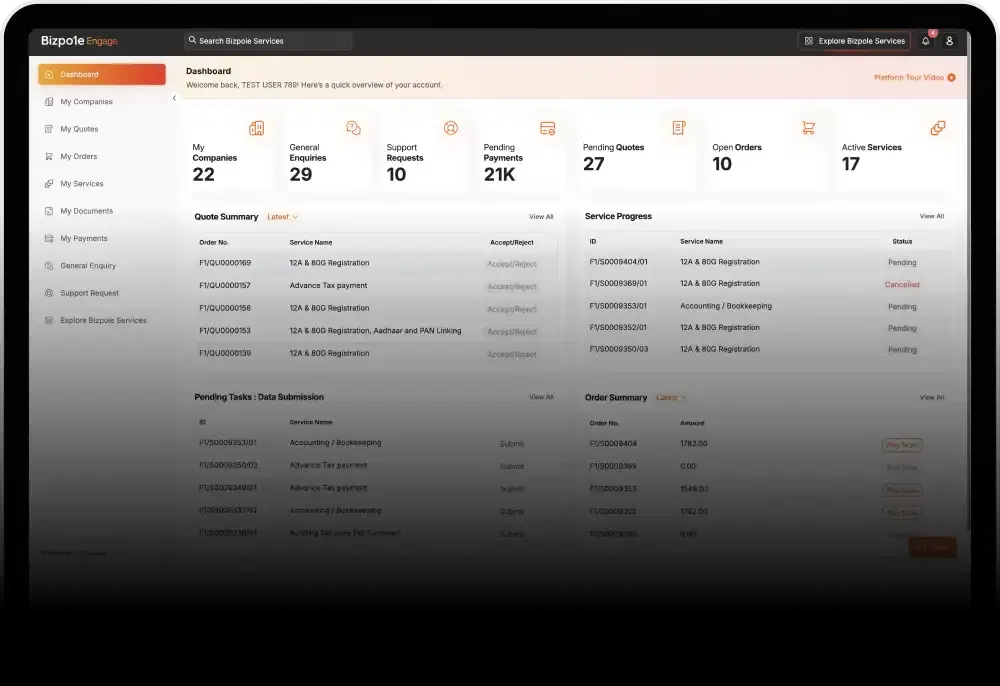
Our experience building Bizpole, our own multi-service platform spanning finance and compliance operations, gives us direct insight into the data consistency and audit-trail requirements that make or break an ERP system in production.
- We build only the modules your operations actually need, avoiding the bloated licensing costs of packaged ERP suites.
- Legacy data migration is treated as a first-class, validated project phase, not a rushed step before cutover.
- A unified data model across modules means leadership reporting reflects one consistent source of truth, not reconciled exports.
Proof in Production
Frequently Asked Questions
Why build a custom ERP instead of buying SAP or Oracle NetSuite?
Packaged ERP suites often charge for modules you won't use and require expensive consultants to configure. A custom ERP includes only what your operations need and is shaped around your actual workflows from the start.
How do you migrate years of historical data from our spreadsheets?
We plan migration as a dedicated phase, validating data consistency before cutover rather than importing everything as-is. Inconsistent historical data gets flagged and resolved before it becomes embedded in the new system.
Can we build the ERP in phases instead of all at once?
Yes, and we recommend it. We typically prioritize the module causing the most current operational pain — often finance or inventory — and expand to other modules in subsequent phases.
Will the finance and inventory modules share data automatically?
Yes, we design one unified data model across modules specifically so stock levels, costs, and financial records stay consistent without requiring manual reconciliation between separate systems.