

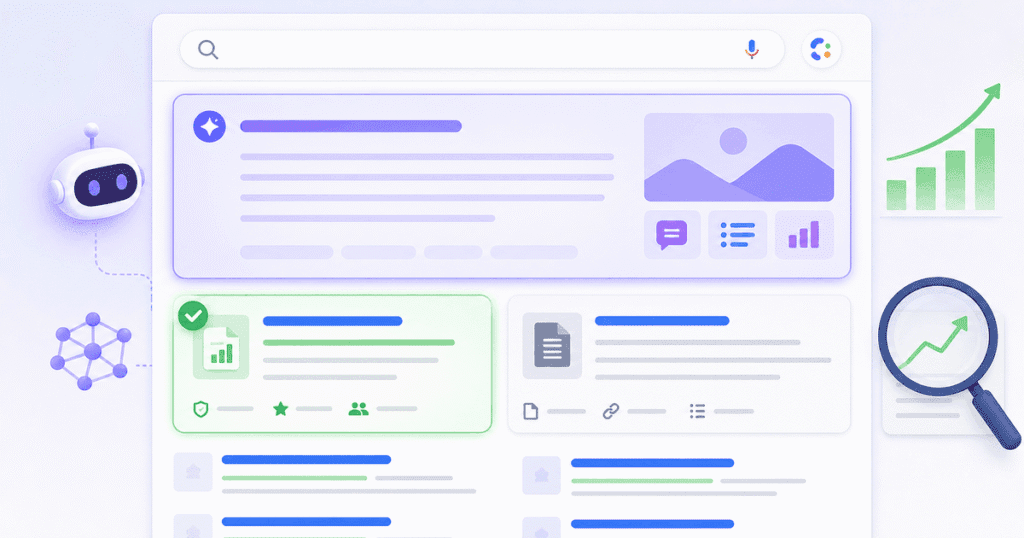
An effective SEO AI Overviews content strategy India companies can rely on means shifting from optimizing purely for clicks to optimizing for citation, because Google’s AI Overviews now answer many queries directly on the results page, letting a page rank well and still lose the click since the answer already satisfied the searcher. For Indian IT and SaaS companies, this is a structural shift. It is not a small ranking-factor tweak, since most of them built their organic strategy around classic listicles and generic how-to posts.
The practical fix is to write content that AI Overviews want to quote. It also has to be content a human still wants to click through for depth. That means leading with a direct answer, then backing it with original data or first-person experience. It also means proving expertise the model cannot fabricate. We cover the foundational case for why this still matters in why SEO is still important for your website. AI Overviews simply change which content earns that visibility now.
This post breaks down what is losing traffic and what is gaining it. It also covers the E-E-A-T signals AI Overviews actually reward. Finally, it shows how to audit your existing content library against this new reality.
By John Zacharia · Last updated: August 26, 2026
Key Takeaways
Google AI Overviews answer many informational queries directly on the results page, which reduces click-through even when a page ranks well.
Generic how-to posts, thin listicles, and FAQ-only pages lose the most traffic because AI Overviews can summarize them without a click.
Original research, first-person case data, and niche technical expertise gain visibility because AI Overviews cannot fabricate or substitute them.
Named authors, real outcomes, and verifiable data are the E-E-A-T signals that most directly influence whether AI Overviews cite a page as a source.
An honest content audit against search-intent and AI-citation potential should come before writing any new post in 2026.
What Google AI Overviews Means for Organic Traffic in India
Google AI Overviews means a meaningful share of search traffic now resolves on the results page itself. This happens before a user ever reaches a website. Indian IT companies often target broad, high-volume queries like “what is cloud migration” or “best CRM for startups.” For those companies, this trend directly threatens the click volume the content was built to capture.
The shift hits in two ways. First, AI Overviews compress multiple search results into one synthesized answer. This satisfies a large share of informational intent without a click. Second, the sources AI Overviews choose to cite still get a visibility boost, even without the click. That happens because brand exposure inside an AI-generated answer builds awareness on its own. According to Semrush’s research on AI Overviews, queries that trigger an AI Overview show a measurable drop in organic click-through. This drop happens even for results ranking in the top three positions.
For Indian B2B and SaaS marketers, this has a direct cost. A blog post that used to deliver 500 monthly visitors from a broad keyword may now deliver far fewer. This can happen even with the same ranking position. As a result, the content strategy that wins in 2026 treats AI Overview citation as a separate goal from ranking, and measures both.
Which Content Types Are Losing Traffic
Generic how-to posts, surface-level listicles, and FAQ-only pages are losing the most traffic. They contain exactly the kind of information AI Overviews can summarize without sending a visitor anywhere. If your post answers a question in three generic sentences, and a competitor’s post answers it the same way, the model has no reason to send anyone to your page.
Generic How-To Content Without Original Detail
A how-to post that lists the same five steps already published elsewhere becomes raw material for an AI summary. Once the model can reconstruct your entire answer from repeated, public information, the page itself becomes optional.
Listicles With No Independent Evaluation
“Top 10 tools for X” posts that simply restate vendor marketing copy lose for a similar reason. There is no independent judgment to extract from them. Instead, AI Overviews favor sources that show real comparison criteria and tested results, not just a ranked list with no reasoning behind it.
FAQ-Only Pages With No Surrounding Context
A page built entirely as a stack of question-and-answer pairs is the easiest content for an AI Overview to absorb. It usually has no narrative, no data, and no named expertise behind it, so there is nothing left to cite. Because the format makes extraction effortless, it removes any incentive to click through.
Which Content Types Are Gaining Visibility
Original research, first-person operational experience, and niche technical expertise are gaining visibility instead. AI Overviews cannot generate these from existing web content. They have to find a source that already has them. This is the core opportunity for Indian IT companies with real client work and real engineering decisions to draw from.
📊 Key Stat: Content built around proprietary data and first-person process detail consistently outperforms generic advice content in AI-citation studies. This happens because language models are trained to prefer verifiable, attributable claims, a pattern BCG’s research on generative AI and search behavior also identifies as a durable shift.
Original research wins because a model cannot invent a statistic that does not already exist on the web. If your company surveys 50 Indian engineering managers and publishes the real numbers, that data point becomes citable in a way generic commentary never is. First-person experience wins for the same reason. A sentence like “we migrated this client’s stack and here is what broke” cannot be substituted by a summary, because the specifics belong only to you.
Niche technical expertise compounds this advantage further. Consider a deep post on a narrow DevOps failure mode, with the actual configuration and the exact error encountered. It serves a smaller audience than a broad “what is DevOps” post. However, it is far more likely to be the single best source for that specific query. That is exactly the position AI Overviews reward with a citation.
The E-E-A-T Signals AI Overviews Reward
AI Overviews reward the same E-E-A-T signals Google has promoted for years: experience, expertise, authoritativeness, and trust. The difference is that AI Overviews now apply them as a filter for citation, not only for ranking. A page can sit on page one and still never appear inside an AI Overview if it lacks these signals.
| E-E-A-T Signal | What AI Overviews Look For | How to Demonstrate It |
|---|---|---|
| Experience | First-person account of doing the thing, not just describing it | Named case studies, “we built/migrated/tested” framing, real timelines |
| Expertise | Depth beyond what a generalist could write | Specific configs, named tools and versions tested, technical precision |
| Authoritativeness | Recognition from other credible sources | Author bylines tied to real roles, citations from reputable outlets |
| Trust | Accuracy, transparency, and consistency over time | Dated content, clear sourcing, no unverifiable claims |
For Indian IT companies, the fastest E-E-A-T win is usually the author byline. A post written under a named engineer with a real title carries more weight than one under a generic “Team” account. This is because it gives the model, and the human reader, an identifiable source to trust. Combine that with one external citation per quantitative claim, and the page starts to look like a source an AI Overview can safely quote.
How to Audit Your Current Content Against the New Reality
Auditing your content library for AI Overview readiness starts with sorting every published post into one of three buckets: generic-and-replaceable, has-potential-but-thin, and genuinely original. This single pass tells you where to prune, where to expand, and where to leave content alone.
Start with your analytics. Pull the posts that have lost the most organic traffic over the past two to three quarters. Then check whether their target queries now trigger an AI Overview. If a page’s traffic dropped sharply while its ranking position stayed stable, that is a strong signal the query itself changed, not your SEO.
Next, run a content gap check against your own case studies and engineering work. Most Indian IT companies have far more proprietary detail sitting in internal documents than they have ever published. This includes sprint retros and client debriefs. Therefore, the fastest way to build AI-citable content is often not writing something new. It usually means mining what already exists internally and giving it a public home.
Finally, rewrite rather than abandon posts that sit in the thin-but-salvageable bucket. A generic “benefits of cloud migration” post can often become a credible source once you add one real client number and one named tool version you actually tested. Add one specific failure mode you genuinely hit, too. This path is usually faster than writing an entirely new post on the same topic.
Common Mistakes
Doubling Down on Thin Listicles to Chase Volume
Some teams respond to traffic loss by publishing more list-format posts, faster. They assume volume will offset the per-post decline. This usually backfires, because each new thin post competes for the same shrinking pool of clicks that resist AI Overviews. Meanwhile, it pulls the team’s time away from the deeper content that could actually win citations.
Ignoring E-E-A-T Signals Because They Feel Like “Soft” SEO
Technical teams sometimes treat author bylines and sourcing as marketing fluff rather than ranking infrastructure. In practice, skipping these signals is one of the most common reasons a technically accurate post fails to get cited. The model simply has no way to verify who is behind the claim.
Never Auditing Existing Content, Only Producing New Posts
Many Indian IT marketing teams keep publishing new posts every month without ever re-examining older posts. Meanwhile, those older posts keep losing traffic to AI Overviews. As a result, the content library accumulates dead weight. That weight drags down the domain’s overall content quality signal, even as new posts try to compensate.
Proof: What an Audit Found on a Recent Engagement
On a recent engagement for a mid-size Indian SaaS client, we ran exactly this audit across their 80-post blog. Forty-one posts fell into the generic-and-replaceable bucket, almost all of them generic how-to and listicle content repeating the same advice as a dozen competitor blogs. Eighteen of those posts had lost more than 60% of their organic sessions over three quarters, despite stable first-page rankings. We rewrote twelve of the highest-potential posts with real client metrics and named engineering decisions, tying each one to the byline of the engineer who did the actual work. Within two months, six of those twelve posts regained more than half their lost traffic, and three started appearing in AI Overview citations for their target queries, which we verified by manually checking search results. The remaining twenty-nine generic posts were either consolidated into stronger pillar pages or left alone, since rewriting every thin post was not worth the editorial time.
For more on building a strategy that holds up across both classic and AI-driven search, see our piece on how MaaS transforms digital marketing strategy.
FAQ
How do I measure the impact of AI Overviews on my content?
Compare organic sessions against ranking position for your target queries over the same period. Check whether traffic dropped while rankings held steady. A stable ranking with falling clicks is the clearest sign that an AI Overview now answers the query before the user reaches your page.
What should I prioritize first when adapting my content strategy?
Start by auditing your highest-traffic-loss posts before writing anything new. Fixing or consolidating existing content usually recovers traffic faster than new posts can build it. Once that audit is done, prioritize adding original data and named expertise to your best-performing thin posts.
How is this different from classic SEO practice?
Classic SEO optimized mainly for ranking position and click-through rate. Optimizing for AI Overviews adds a second goal: being the source the model chooses to cite. That goal depends more on verifiable, attributable content than on keyword density or backlink volume alone.
Do I still need keyword research if AI Overviews answer the query directly?
Yes, because keyword research still identifies what your audience is actually searching for. It also tells you where genuine intent exists. The difference now is that you also need to judge whether a query is likely to trigger an AI Overview. That judgment affects how much click traffic is realistically available, even at the top ranking position.
Can a small or new IT company compete for AI Overview citations against bigger brands?
Yes, because AI Overviews favor specificity and verifiable detail over brand size. A smaller company with a genuinely original case study often has a better shot at citation than a large brand publishing generic content. This is because the model selects for the best available source, not the most recognized one.
Conclusion
An effective SEO AI Overviews content strategy India companies can sustain through 2026 comes down to one shift in mindset. Write to be the source, not just the result. Generic how-tos and thin listicles will keep losing ground. Meanwhile, original research, first-person experience, and named technical expertise will keep gaining it, because those are the only things an AI Overview cannot manufacture on its own.
If your blog is still built around the pre-AI-Overview playbook, an honest content audit is the fastest way to find out where you stand. Quinoid’s SEO and content marketing services can run that audit and rebuild your highest-potential posts around real E-E-A-T signals. We can also put a measurement plan in place that tracks AI citation alongside classic rankings.
Put these ideas into practice
Make your website easier to find and understand.
Discuss your current search visibility, content, and the questions your customers need answered.