
AI healthcare India machine learning tools are already live inside real clinics today, flagging abnormal chest X-rays before a radiologist opens the file, generating SOAP notes from recorded consultations, and predicting which patients will skip appointments — all running on production models and data pipelines built to meet India’s regulatory expectations for software that touches patient care.
This matters because India’s healthcare system carries a structural mismatch: too many patients, too few specialists. Clinical data is also fragmented across thousands of providers who rarely share a common record format. Machine learning does not fix that mismatch by itself. However, it can let a smaller clinical team handle a larger patient load without dropping quality. That only holds true if the tool is built and deployed correctly. For a broader look at where AI fits across an enterprise software roadmap, see our guide to AI development for regulated industries.
By Kurian Benny · Last updated: August 24, 2026
Key Takeaways
AI healthcare India machine learning tools are already live in tier-2 clinics for radiology triage, not just in metro hospital pilots.
Clinical note automation from doctor-patient audio can give physicians back meaningful time per patient, but only with a human review step before notes enter the record.
India’s CDSCO treats most diagnostic-support software as a medical device, which means a formal risk classification before commercial deployment.
Labelled medical data remains the biggest bottleneck for Indian healthcare AI, more than compute cost or model choice.
The Digital Personal Data Protection Act adds a compliance layer that most early-stage healthcare AI pilots underestimate until an audit forces the issue.
India’s Healthcare AI Opportunity: Scale Meets a Real Data Gap
India’s healthcare AI opportunity exists because patient volume has outgrown specialist supply. Machine learning is one of the few tools that scales without scaling headcount at the same rate. The country has long faced a shortage of qualified doctors relative to population. This is especially true in rural and tier-2 towns. A single radiologist or pathologist there often serves a catchment area far larger than urban norms. The World Health Organization has flagged doctor-to-population ratios in many developing health systems as a persistent constraint on care quality. India’s own public health planning documents echo the same concern.
Infrastructure adds a second layer to the problem. Many tier-2 and tier-3 facilities run on inconsistent internet connectivity, older imaging hardware, and small IT budgets. As a result, any AI tool deployed there has to work offline-first or on thin bandwidth. Therefore, the winning healthcare AI products in India are rarely the most sophisticated models. Instead, they are the ones that run reliably on modest hardware and degrade gracefully when connectivity drops.
📊 Key Stat: Industry estimates from health-sector market research place India’s healthcare AI market on a steep multi-year growth trajectory through the late 2020s. This growth is driven primarily by diagnostic imaging and administrative automation, not novel drug discovery. Government health bodies, including India’s Ministry of Health and Family Welfare, have separately flagged workforce shortages. They cite it as a structural driver behind digital health adoption. That lines up with what we see in deployment conversations with hospital groups.
Use Case 1: Radiology AI for Chest X-Ray Triage at Tier-2 Clinics
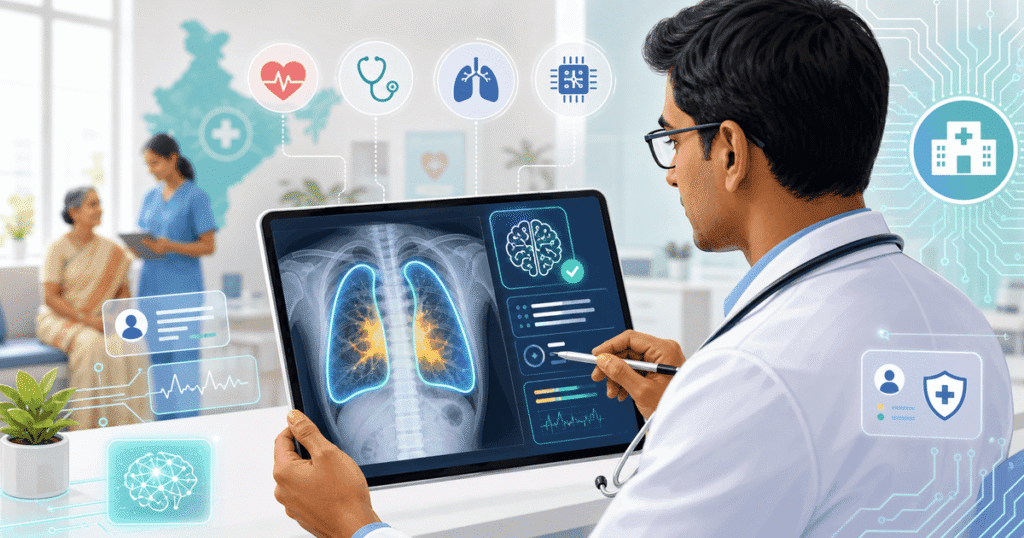
Radiology AI for chest X-rays flags likely abnormalities before a radiologist reviews the image. That includes opacities, nodules, and signs consistent with tuberculosis or pneumonia. This speeds up triage in facilities that see far more films than they have specialists to read. In a tier-2 clinic without a radiologist on-site, a model often pre-sorts incoming X-rays into “likely normal” and “needs urgent review” queues. As a result, the visiting or remote radiologist spends limited hours on the cases that matter most.
This is not a hypothetical use case. Tuberculosis screening programs across South and Southeast Asia have piloted automated chest X-ray analysis for a specific reason. TB remains a high-burden disease in exactly the geographies that lack enough trained radiologists, a pattern documented in the World Health Organization’s tuberculosis fact sheet. The technical pattern behind it is a convolutional or transformer-based image classifier, trained on labelled chest X-ray datasets. It typically runs behind a simple upload interface that a clinic technician, not a radiologist, can operate.
💡 Pro Tip: Clinics evaluating radiology AI vendors should ask for the model’s sensitivity and specificity on a population that resembles their own patient base. A vendor’s published benchmark alone is not enough. A model tuned on urban hospital data can perform very differently on a rural population, because disease prevalence and image quality both shift.
Use Case 2: Clinical Note Automation from Doctor-Patient Audio
Clinical note automation converts a recorded doctor-patient conversation directly into a structured SOAP note: Subjective, Objective, Assessment, Plan. This cuts the documentation time that otherwise eats into a physician’s day. Indian doctors in high-volume outpatient settings frequently see far more patients per day than their counterparts in lower-volume health systems. As a result, any time saved on typing notes translates directly into more patient time, or less unpaid overtime.
The underlying architecture pairs a speech-to-text layer with a language model that structures the transcript into clinical sections. Medical terminology and accent variation make this harder than general transcription. Because of that, most production systems also run a domain-specific layer to catch drug names, dosages, and clinical shorthand correctly. Our breakdown of which programming language fits AI workloads covers why this matters. Most pipelines like this mix Python for the model layer with a JavaScript or TypeScript front end for the doctor-facing interface.
No clinical note automation tool should auto-submit a note without a human-in-the-loop review step. A physician must read and confirm the generated note before it enters the patient record. An unreviewed transcription error in a dosage or diagnosis field is not a minor UX bug. It is a patient safety issue.
Use Case 3: Appointment No-Show Prediction and Scheduling
No-show prediction models flag which scheduled appointments are statistically likely to be missed. A clinic can then overbook those slots or send targeted reminders, instead of losing the revenue and capacity outright. This is a lower-stakes, faster-to-deploy use case than diagnostic AI, because it touches operations rather than clinical decisions. That means a much lighter regulatory burden.
The model typically trains on historical appointment data: time of day, distance from the clinic, payment method, prior no-show history, and weather on the appointment date. Together, these produce a simple risk score per booking. Hospital administrators we have worked with use that score for staffing decisions. A high-risk booking gets an automated reminder call 48 hours out, while a low-risk one gets a simple text message. This concentrates limited reminder-call staff time on the bookings most likely to fall through.
| Use Case | Regulatory Burden | Typical Deployment Time | Core Risk |
|---|---|---|---|
| Radiology AI (chest X-ray triage) | High — SaMD classification likely required | 3-6 months including validation | False negatives on real disease cases |
| Clinical note automation | Moderate — depends on whether output is treated as the record of truth | 4-8 weeks for a reviewed pilot | Transcription errors entering patient records unreviewed |
| No-show prediction / scheduling | Low — operational, not diagnostic | 2-4 weeks | Biased predictions reducing access for some patient groups |
Regulatory Context: What CDSCO Requires for Software as a Medical Device
India’s Central Drugs Standard Control Organisation, or CDSCO, treats software that supports a diagnosis or clinical decision as Software as a Medical Device. This means it falls under the same regulatory framework as physical medical devices. In practice, a radiology triage tool that flags abnormal X-rays needs a formal risk classification before commercial deployment. Its output directly influences a clinical decision, after all.
The classification process groups devices into risk classes. That class determines how much clinical validation evidence a manufacturer must submit before approval. A tool that only assists with workflow, like the no-show predictor above, typically falls outside SaMD scope entirely. A tool that contributes to a diagnosis, however, sits squarely inside it. Therefore, the regulatory path a healthcare AI product takes depends heavily on how its output is framed. The clinical workflow it serves matters more than the underlying technology.
Hospitals and clinics evaluating a vendor’s AI tool should ask directly whether the product has, or needs, CDSCO classification before signing a contract. A vendor who cannot answer that question clearly is asking the hospital to absorb regulatory risk it may not have budgeted for.
The Data Challenge: Labelled Medical Data Scarcity in India
Labelled medical data scarcity is the single biggest bottleneck for healthcare AI in India, ahead of compute cost or model architecture choice. Training a reliable diagnostic model requires thousands of correctly labelled examples. That means X-rays annotated by a radiologist, audio transcripts verified against the actual clinical note, and appointment records cleaned of duplicate or incomplete entries. Most Indian hospital systems were never built to produce that kind of structured, exportable dataset.
This gap shows up differently across the three use cases above. Radiology models need radiologist-annotated images at scale, which is expensive. After all, it consumes the same scarce specialist time the AI tool is meant to offload. Clinical note models need verified transcript-to-note pairs across multiple accents and specialties. Scheduling models need clean historical appointment data, which sounds easier but often is not. Many smaller clinics still run scheduling on paper or in disconnected spreadsheets.
Because of this, the most successful Indian healthcare AI deployments we have seen start small. They begin with a narrow, well-defined task and a realistic data-collection plan, rather than an ambitious model trained on whatever data happens to be lying around. A tool built on 500 carefully labelled, representative cases consistently outperforms one built on 5,000 noisy, inconsistent ones.
Common Mistakes
Skipping CDSCO Classification Until Late in the Project
Teams often build and pilot a diagnostic AI tool first, then discover during a hospital procurement review that it needs formal SaMD classification. This is an expensive mistake. Regulatory requirements can change the model’s validation approach, documentation, and even its UI disclosures. All of that is far cheaper to design in from day one than to retrofit after a working pilot is already in clinical use.
Ignoring the Digital Personal Data Protection Act’s Consent Requirements
India’s Digital Personal Data Protection Act sets specific rules around consent, data minimisation, and breach notification for personal data. Patient health data sits squarely within its scope. Healthcare AI pilots that collect patient audio, images, or records without a clear consent and data-retention policy are building on a compliance gap. That gap surfaces the moment a hospital’s legal team or an auditor asks for documentation.
Underestimating How Much Labelled Data the Model Actually Needs
Founders frequently assume a small proof-of-concept dataset will scale smoothly into a production-grade model. However, diagnostic accuracy on a narrow pilot set rarely holds up once the model meets the full variability of a real patient population. Budgeting for ongoing data labelling matters more than an initial training set alone. That ongoing investment is what separates a demo tool from one that works in daily clinical use.
Proof: What a Realistic Radiology AI Rollout Looks Like
A realistic chest X-ray triage rollout we have seen succeed follows a deliberately staged path, not a single big-bang launch. One clinic group started with a single facility and ran the model in shadow mode for eight to twelve weeks, where it generated predictions that radiologists never saw or acted on, while the team compared those predictions against the radiologists’ actual findings to measure real-world accuracy first. Only after that shadow period showed consistent agreement with radiologist findings did the tool move into an assistive role, surfacing a priority flag on the worklist rather than a diagnosis. This staged sequencing builds the validation evidence a CDSCO submission needs, and it builds clinical staff trust gradually, instead of asking radiologists to trust an unproven system from day one. The same staged-rollout discipline applies to any AI system entering a regulated healthcare software development engagement, regardless of the specific clinical use case it serves.
FAQ
How much does it cost to build a healthcare AI tool in India?
Cost depends heavily on the use case and regulatory path. An operational tool like no-show prediction can often be built and piloted within a modest budget over a few weeks. A diagnostic radiology tool costs significantly more, once CDSCO validation, radiologist-annotated training data, and clinical pilot infrastructure are factored in.
How long does CDSCO approval take for a diagnostic AI tool?
Timelines vary by risk classification and the completeness of the validation evidence submitted. However, teams should plan for several months at minimum once classification, documentation, and clinical validation data collection are included. That estimate covers more than just the formal review window itself.
Is AI more accurate than a manual radiology review?
AI triage tools are designed to support a radiologist’s review, not replace it. The strongest deployments combine both: the model flags likely abnormalities quickly, and the radiologist makes the final call. Framing the comparison as AI versus manual review misses how these tools actually get deployed safely.
Do small clinics need the same regulatory compliance as large hospitals?
Yes. CDSCO’s SaMD classification applies based on what the software does, not the size of the facility deploying it. A diagnostic-support tool carries the same classification requirement, whether it runs in a metro hospital chain or a single tier-2 clinic.
What is the biggest blocker to AI adoption in Indian healthcare right now?
Labelled, representative clinical data is the most common blocker we see, ahead of budget or regulatory complexity. Hospitals that invest early in structured data collection consistently move faster through both model development and CDSCO validation. That holds true compared with those that try to source data after the fact.
Conclusion
AI healthcare India machine learning adoption is no longer a future bet. It is already running in radiology queues, doctor consultation rooms, and hospital scheduling desks across the country. The clinics and hospitals winning with it treat regulatory classification, data labelling, and human review as part of the build. They are not afterthoughts bolted on once a pilot already works in a demo.
If your team is evaluating a healthcare AI tool or planning a CDSCO-aware deployment, Quinoid’s AI development team can help. We build machine learning systems for regulated industries with that compliance and data reality built in from day one, not retrofitted after launch.
Put these ideas into practice
Explore where AI could help your business.
Discuss your workflow, available data, and the result you want before deciding what to build.